Quarantine: Governmental and Human Responses
- Dan Gelles
- Mar 20, 2020
- 4 min read

THE PRESIDENT OF THE ARGENTINE NATION IN GENERAL AGREEMENT OF MINISTERS
DECREES:
ARTICLE 1º.- In order to protect public health...the measure of “social, preventive isolation is established [mandatory quarantine] for all persons who live in the country or are in it temporarily and mandatory ”in the terms indicated in this decree. It will be in force from March 20 to 31, inclusive of the current year, and this period may be extended for the time considered necessary in light of the epidemiological situation…
Those who are complying with the isolation provided for in article 1, may only make minimal and essential trips to stock up on cleaning supplies, medicines and food…
ARTICLE 4º.- When there is an existence of an infringement of compliance...the conduct will immediately cease and the competent authority will act, within the framework of articles 205, 239 and concordant of the Penal Code…
Source: The Official Bulletin of the Argentine Republic (rough English translation)

A newly erected sign on Scalibrini Ortiz Avenue in Buenos Aires, Argentina that translates to "Stay at Home" March 19, 2020.
I never thought that I would live through a period of encroaching martial law while residing in a Latin American country, but it seems as though there were other plans in store for me. This statement was released the evening of March 19th, 2020, which was an extremely stressful day. With news and conditions changing very fast, I had to work to resecure my housing here and stock up on supplies.

The living room of my apartment in the neighborhood of Palermo Soho, Buenos Aires, Argentina. March 20, 2020.

The view from the balcony of my apartment in the neighborhood of Palermo Soho, Buenos Aires, Argentina. March 20, 2020.
While I do not have an exact understanding of conditions outside of my neighborhood, I can personally report that the neighborhood of Palermo Soho was not in a complete state of panic. During my trip to the grocery store last night, what I witnessed was an example of a nation taking necessary steps to ease a population into a state of quarantine. The grocery stores were also remarkably well stocked. The only empty shelves were the ones containing pastas and other cereal oriented products. Lines for grocery stores did wrap around the block, but it was orderly. Only a certain number of people allowed in stores at a time. Upon entering, people were greeted by bottles of hand sanitizer and (optional) plastic gloves. Everyone kept a healthy distance, but no one appeared to be rushing.

A line of customers waiting for a branch of the COTO grocery chain to be let in following new regulations in Argentina curtailing the amount of customers allowed in a store at any given time. March 19, 2020.

Just hours before the 10 day government mandated quarantine, customers wait outside a pharmacy in the neighborhood of Palermo Soho in Buenos Aires, Argentina. March 19, 2020.
In comparison to the sources I have back in the United States, the climate in Argentina is far calmer (at least based on what I witnessed). Part of that may stem from the fact that there are only 128 cases in the entire country, but I believe that it stems from something deeper.
Argentina, has not enjoyed a stable political or economic climate following the Second World War by any measure. Between 1976 and 1983 they had a military dictatorship (here commonly known as “El Proceso”) that resulted in the abduction and execution of citizens who resisted, or more often than not, were only suspected of resisting the regime. A common mode of execution involved stripping captives naked, drugging them, and throwing them out of helicopters over the Atlantic Ocean, death flights. Not even pregnant women were spared. Following the birth of their child, they were executed. Their newborns were given to families of the military regime. On the economic side, there have been numerous crises of catastrophic proportions. Between 1998 and 2002, Argentina had an economic crisis that plunged millions of Argentines below the poverty line. In 2018, they had yet another economic crisis which led to hyperinflation of their currency and an economic downturn which is still felt and discussed here daily.
The Argentine people are no strangers to crises. The sum of all the horrors they experienced in the last several generations exist in their collective memory. In the United States, we are more privileged. The concept of there being a finite amount of consumer goods is but an abstract idea in our minds. Furthermore, despite the United States inevitably shutting down, our government will be providing all citizens $1,000 per month to offset economic hardships. It is near impossible to imagine Argentina having the economic power to ensure a payout that large for all their citizens. One thing that we need to be mindful of is not just the medical impact of the Coronavirus, but the economic one.
The person I have been thinking about the most today is a man whose name I do not know. Before the outbreak I saw him regularly. He sat in the stairwell of my neighborhood Subte (Subway) station, Scalibrini Ortiz, selling avocados at a rate of 3 for 100 pesos. I wonder how he is doing today.
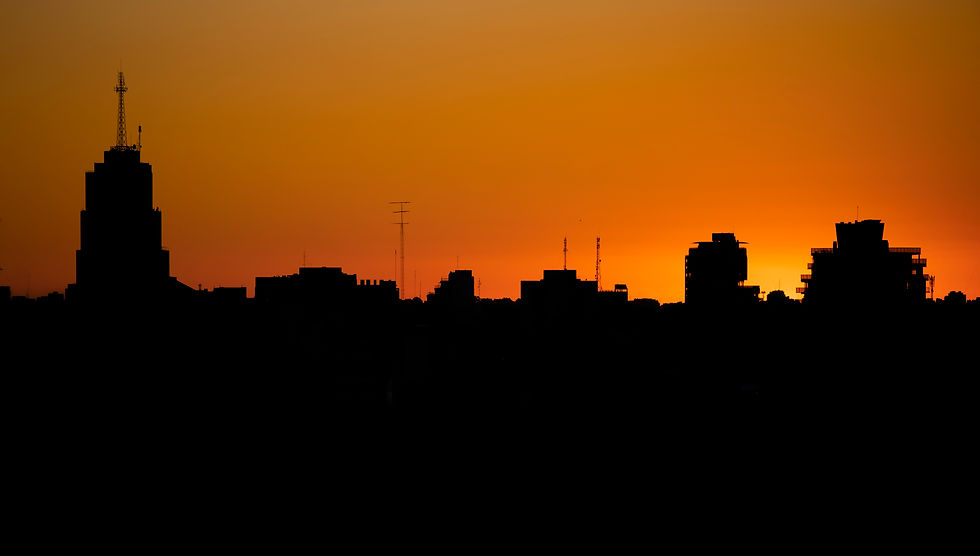
A sunset over the Buenos Aires cityscape. March 20, 2020.


Comments